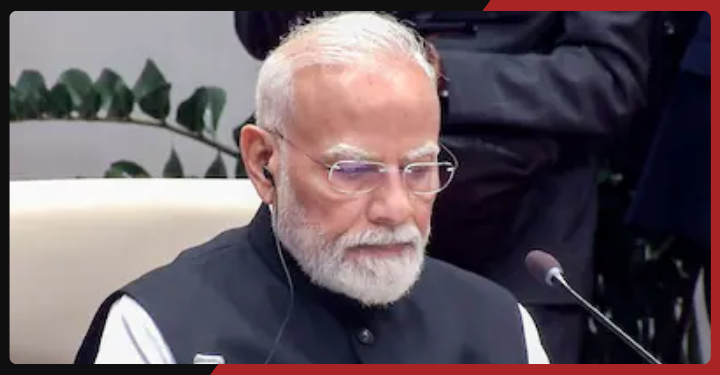

The Kashmir conflict has been one of South Asia’s most sensitive and enduring flashpoints. So, when former U.S. President Donald Trump claimed during a joint press conference with Pakistani Prime Minister Imran Khan that Indian Prime Minister Narendra Modi had requested his mediation on the matter, it was more than just a gaffe—it triggered a diplomatic chain reaction.
The claim itself was startling. Trump said, “He actually said, ‘Would you like to be a mediator or arbitrator?’ I said, where? He said, ‘Kashmir.’” Coming from the leader of the world’s most powerful democracy, the statement immediately raised questions about Washington’s position on Kashmir, which has traditionally been one of non-intervention.
India reacted with urgency and clarity. The Ministry of External Affairs issued a formal denial, stating, “No such request was made by Prime Minister Modi.” The response reflected more than a desire to correct the record—it was a firm reassertion of India’s core diplomatic principle: Kashmir is a bilateral issue, not one to be solved with outside assistance.
India’s Parliament witnessed rare unanimity as both the government and opposition condemned Trump’s assertion. Members demanded clarification and accountability, reflecting how seriously the Indian establishment views any suggestion of third-party involvement in Kashmir.
For India, the principle of bilateralism on Kashmir is not negotiable. It is rooted in the Simla Agreement (1972), in which both India and Pakistan agreed to resolve disputes through direct dialogue. New Delhi views any departure from this framework as a threat to national sovereignty.
Across the border, Pakistan received Trump’s statement with open arms. Prime Minister Imran Khan, who has long lobbied for international mediation, applauded Trump’s offer. At a press event in Washington, Khan said, “The U.S. is the only country that can bring India to the table. We are ready for dialogue if India agrees.”
This divergence in reaction exposed the fundamental differences in how both nations approach the Kashmir issue. While Pakistan sees international mediation as a means to break the deadlock, India sees it as an intrusion.
American officials quickly worked to manage the fallout. Within days, the State Department issued a clarification, affirming that the U.S. position remained unchanged and that Kashmir was to be resolved bilaterally. U.S. diplomats reassured Indian counterparts that Trump’s remarks did not represent a policy shift.
Even so, the incident caused temporary strain. It reignited fears in New Delhi that international actors could be swayed by Pakistan’s persistent campaign to globalize the Kashmir issue. The worry wasn’t that the U.S. would actually mediate—but that the perception of a willingness to do so could embolden separatist narratives and undermine India’s diplomatic footing.
The incident also revealed a flaw in Trump’s diplomatic style. Known for his impulsive public statements, Trump often treated geopolitics like business deals. But Kashmir is not a boardroom problem—it is a highly emotional, deeply historical conflict. Any attempt to treat it casually can have far-reaching consequences.
Public sentiment in India was inflamed. Nationalist rhetoric surged on social media, and television debates turned combative. In a country where Kashmir is seen as an integral part of its identity, even a perceived slip-up from a friendly nation like the U.S. touched a nerve.
However, seasoned diplomats urged restraint. They recognized Trump’s comment as more blunder than betrayal. “Trump’s statement was likely off-the-cuff,” said Shivshankar Menon, former National Security Advisor of India. “But the government had no choice but to respond firmly. You can’t allow ambiguity in matters of sovereignty.”
In the broader scheme, the episode did not derail India-U.S. ties. Defense cooperation, strategic dialogues, and trade discussions continued as usual. Yet the incident underscored a critical lesson: even long-standing allies must be cautious in navigating the emotional terrain of South Asian geopolitics.